
CASE STUDY: Transport for London
Summary
-
TfL needed to ensure its fatigue management programme reached all staff, including operational shift workers traditionally seen as hard-to-engage.
-
Night Club delivered tailored, sleep expert-led training and engagement activities across multiple staff groups and sites, supported by peer-to-peer Sleep Champions and a programme of insights and evaluation.
-
Over 450 staff directly supported, with 60–70% reporting improved sleep and shift wellbeing in follow-up surveys. TfL observed increased engagement with its fatigue management programme, and found rich value from the insights work delivered by Night Club.
OPPORTUNITY
Transport for London (TfL) supports billions of passenger journeys each year. Safety is a top corporate priority, and fatigue is a significant operational risk. The pan-TfL fatigue management programme, covering approximately 29,000 directly employed colleagues, sets clear standards across the organisation.
TfL identified a need to ensure all elements of its fatigue management programme - training, culture change, and support - reached every part of its workforce, including those traditionally viewed as hard-to-engage, such as operational shift workers.
NIGHT CLUB’S SOLUTION
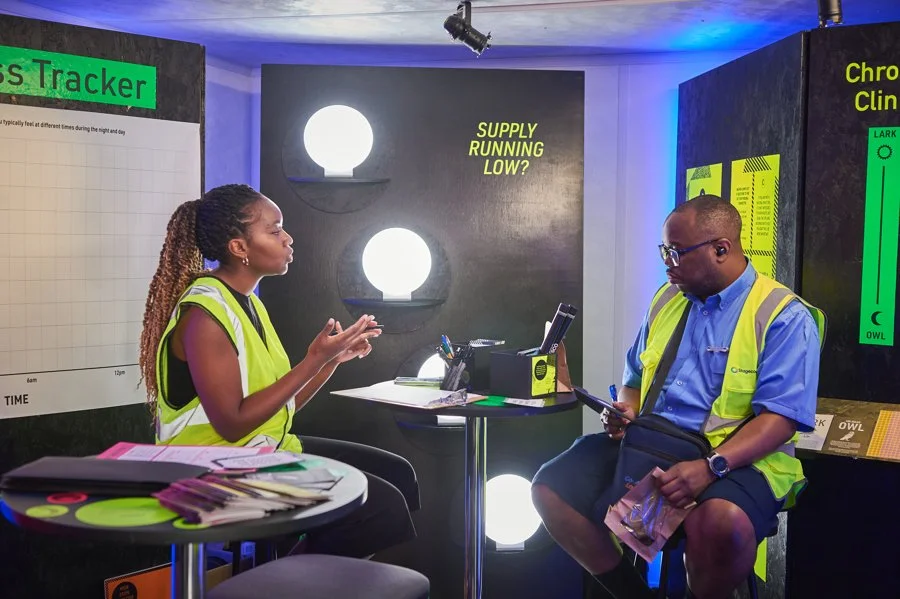
Following Night Club’s work on a 2021 TfL Innovation Challenge and a 2023 competitive tender, TfL commissioned Night Club to deliver sleep expert-led training and engagement for shift workers. Training was tailored to staff groups and site facilities:
Desk-based control centre workers used the Flex, a sleep exhibition and learning space at TfL HQ.
Overnight maintenance teams used the Max, a shipping container providing an exhibition and learning venue at an industrial depot site)
Dial-a-Ride drivers and managers used the Mini, a small portable version of the Night Club kit that toured four depots.
Night Club also implemented a Sleep Champions peer-to-peer initiative and an enhanced programme of insights and evaluation, building understanding of the challenges facing shift workers and how best to support them in delivering TfL’s fatigue management plan.
IMPACT
450 colleagues supported directly by Night Club (2023–2024), with many more reached indirectly through peer-to-peer support and communications campaigns.
92% of participants learned something new to improve their sleep quality.
3-6 month follow-up: over 60% of staff reported improved sleep quality and quantity, and 70% agreed that mood across shifts had improved.
Insights gathered from feedback forms, research interviews, and expert observations were described by TfL as “yielding rich and practical new insight.”
A senior TfL representative observed: “There’s been a real increase in engagement with the fatigue programme as a whole [...] because of the engagement we’ve had with the Night Club.”
Building on this work, Night Club was commissioned to deliver further work by TfL, notably delivering training and education to over 800 London bus drivers across six garages in 2024.
CONCLUSION
TfL’s partnership with Night Club demonstrates the value of investing in shift-worker support as part of a fatigue management plan. Most workers reached saw improved sleep outcomes, and the business benefited from increased engagement and operational insight, supporting the safe and effective running of its services.
NEXT STEPS
Find out how Night Club can support your shift workers.